Rooftop Fans for Poultry Houses and Greenhouses
Two buildings, one principle
A poultry house and a greenhouse look nothing alike — birds in one, plants in the other. The ventilation problem is the same anyway. Heat and moisture build up all day in both, stale air has to leave, fresh air has to come in, and the roof exhaust fan is the exit at the top of the circuit. That shared principle is why the manufacturer's pages treat the two buildings together: the slope and elbow pages both list poultry houses, livestock farms and greenhouses, and the elbow page puts the principle in a single sentence — its fan creates a negative-pressure indoor environment while introducing fresh air. This article sticks to what those pages list for each building type, and marks the places where they say nothing.
What the pages list for poultry houses
On the slope page, the fan serves factories, poultry houses, greenhouses and warehouses in Southeast Asia's climate; its agricultural applications run to large farms, greenhouses and livestock farms. The elbow page's agricultural list reads large-scale farms, greenhouses and poultry and livestock. Airflows: elbow models 28,000 to 45,000 cubic metres per hour, noise 55 to 65 dB; slope models 28,000 and 45,000. Both families take 380 or 220 volts at 50 hertz, six blades as standard. Rates per bird, house sizes, bird counts, temperature targets — neither page gives any of them, and none is claimed here. Those rates turn on the birds, the house, the climate and the season. They need a project calculation, with the house described, not a general article.
What the pages list for greenhouses
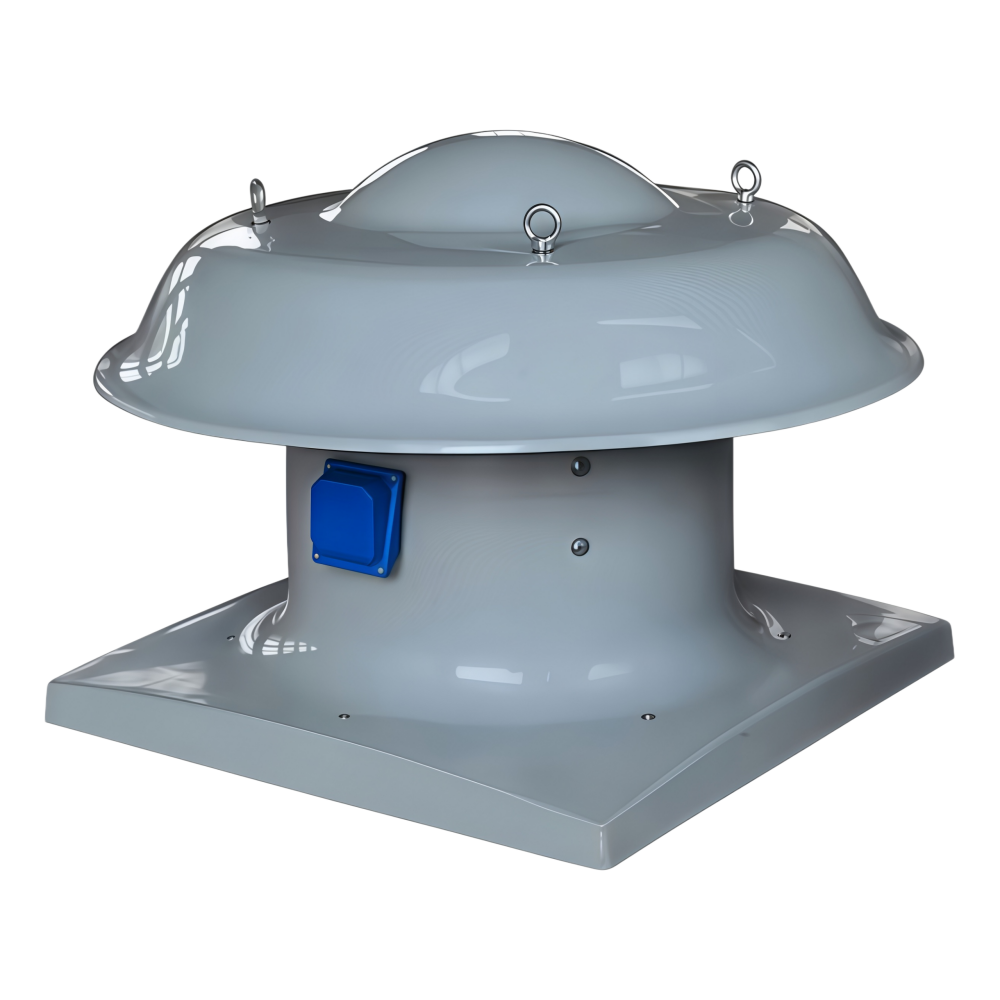
The greenhouse case rests on the same two pages and the same two families. Rain is the slope family's argument on a greenhouse roof: a waterproof dome-shaped cap, a wind deflector and a 1.9-metre awning, where a leak lands on the crop. The elbow family's argument is the outlet — PVC shutters against flies and backflow — in a growing house where insects stay out and cold air must not drift back in overnight. FRP housings suit the humidity in both: the elbow family's smooth-surfaced housing is described as UV and weather resistant. One structural note: the greenhouse page here carries a guide section on greenhouse ventilation as a topic, because search results mix guides and tips in with fan listings. The topic question comes first; the product question follows. This article keeps that order.
Airflow, noise, and the houses they serve
Same verified figures for both buildings. Elbow: 28,000 to 45,000 cubic metres per hour, noise 55 dB on the smallest model, 60 dB on the two middle models, 65 dB on the largest. Slope: 28,000 and 45,000, and no published noise figure — a slope buyer with a noise limit has to ask. Why noise matters differs. Where a project carries a noise limit, the elbow figures give the inquiry a starting point, and the slope figure becomes one more question to put to the supplier rather than an assumption to make. Birds live with the fan sound around the clock; a greenhouse fan may sit beside housing or offices. Fan counts per house, inlet sizes, control schedules — no source page gives them for either building type, and this article invents none. Floor area alone never sizes a fan count. Without the house described, any such number is a guess, birds or plants alike.
Housing material in humid air
The air in both buildings is humid; poultry air adds dust, feathers and ammonia. Bare steel suffers in that air, which is the case for smooth, corrosion-resistant housings: the slope family's hand-laid glass-fibre-reinforced plastic shell with a secondary-treated smooth surface, the elbow family's SMC fibreglass frame and blades with a smooth-surfaced FRP housing. Blade options cut the same way. Slope lists 7 nylon blades and 3 cast aluminium blades as options against its standard six-blade SMC assembly; elbow lets blade material be customized to cast aluminium, nylon or stainless steel. The house's air decides the material, in the inquiry, with conditions described. Price alone should not decide it.
Inlets, and the negative-pressure circuit
Negative pressure is a circuit, not a fan. The elbow page's principle only works whole: fans pull air out, inlets admit fresh air placed to sweep the building. Chilling the birds is the failure mode in a poultry house; short-circuiting from one opening to the next is the failure in a greenhouse. Positions of inlets and fans, and how fan numbers track the season and the stock or crop in the house — that is the design work, and no source page publishes an inlet size or a fan layout for either building type. Describe the house in the inquiry — dimensions, openings, crop or birds, climate — and ask for the layout. Ordering fans first and hoping the circuit forms itself gets it backwards. A fan without its inlet circuit is a machine without a system.
The thermostat question
Thermostat shows up constantly in greenhouse fan searches — greenhouse fans with thermostats, greenhouse exhaust fans with thermostats. The underlying question is sound: should fans run on temperature control? The pages answer it with silence. No thermostat model, no thermostat control, no staged-control schedule is listed anywhere in the sources, so no thermostat feature is claimed for any model here. Ask it as a question, with existing controls described: start and stop on temperature, staging in numbers against the season, what the house already has. Poultry houses need the same conversation — seasonal staging counts there as much as temperature switching. Control is part of the layout. Specify it with the layout, not after installation.
What to send with the inquiry
House first, fan second — that is the inquiry that gets a useful answer. Dimensions, what the house holds, local climate, roof openings available, voltage at the fan positions. Then the layout: which models, how many, where, which inlets, which control. Confirm the tabled figures from the family page for every model quoted. Then the items no source page states — MOQ, lead time, warranty — before any payment. The order pays in both buildings, because the ventilation is the climate and the climate is the production. Get the layout in writing, check it against the house, and only then talk about fans as products. A written layout can be checked model by model against the family pages before anything is ordered; a verbal promise cannot.
Facts used here come from the manufacturer's own product pages for the slope-type and elbow-type FRP rooftop fans. No ventilation rate, coverage, temperature or cost figure appears here that those pages do not state — those numbers depend on the building, the stock or crop, and the climate, and they belong in a project inquiry, not a general article.
Request a rooftop fan layout
Send your building type, roof opening, and voltage, and ask for a layout using the fan families on this page. Before payment, confirm MOQ, lead time, voltage, and warranty for your order.