FRP rooftop exhaust fan
Slope, elbow and FRP DWT-I tables.
Rooftop exhaust fans from Foshan, China — FRP slope and elbow fans, carbon-steel and FRP axial DWT-I roof fans, for factories, warehouses, farms and commercial buildings.
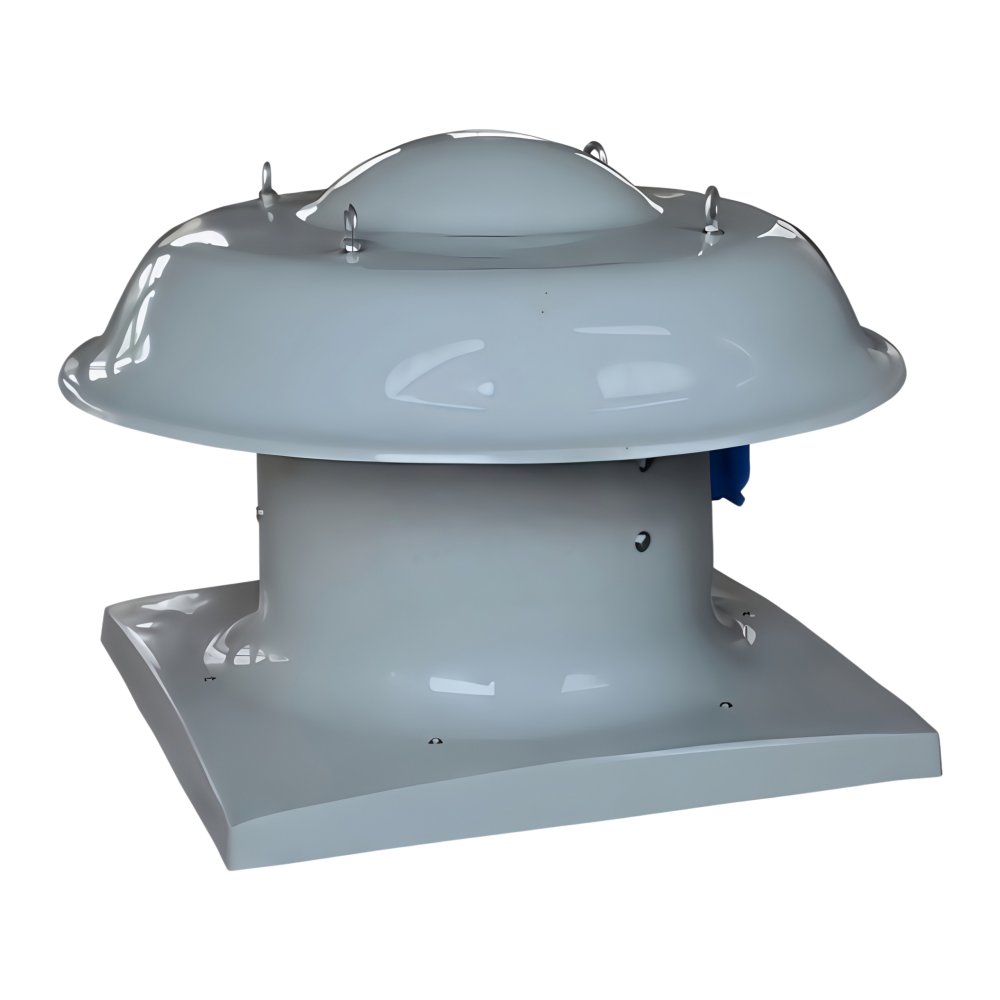
Choosing a rooftop exhaust fan is a sequence, not a single decision. Application first, then airflow and pressure, then voltage, then discharge direction, then housing material — and at each step the manufacturer’s published tables, not catalogue adjectives, decide. This guide walks the sequence in order, using only figures the source pages publish.
Start by writing down the building and what is in its air. A factory workshop, a warehouse, a poultry house, a greenhouse, a store, a power station — each appears on at least one source page, and each has different air: factory air may carry fumes, steam or dust; poultry air carries heat, moisture and ammonia; greenhouse air is humid by design; warehouse air is mostly hot air under the roof. The gas question must be asked at this step, not later: the FRP DWT-I page states gas limits that belong to that variant, and the carbon-steel page states an explosion-proof version is available for flammable, explosive and corrosive-gas environments. If the air is anything but plain warm air, say so in the inquiry, with the temperature and the substances named. A fan chosen without the air described is a fan chosen blind.
Take the airflow from the table of the family being considered, and read the table the way it is printed. The slope and elbow tables give one airflow per model: 28,000 and 45,000 m³/h for slope, 28,000 to 45,000 m³/h for elbow. The DWT-I tables give two airflow ranges per model — two operating points — from 1,900 m³/h on the smallest to 53,855 m³/h on the largest carbon-steel row and 53,800 m³/h on the largest FRP row, with total pressures in the low hundreds of pascals. No source page states a coverage area, an air-change rate, or a temperature drop, so this guide states none: matching airflow to a building is a project calculation using the building's size, height, openings and heat sources. Send those facts with the inquiry and let the supplier lay out the fans; a supplier who quotes a fan count from floor area alone is guessing. Check the pressure column as well as the airflow column, because a fan that moves the right volume against the wrong resistance does not do the job.
Slope and elbow models are tabled at 380 or 220 V and 50 Hz, and the slope page notes that special voltage and power parameters can be customized. The DWT-I tables list power and speed but no voltage column, so DWT-I voltage must be confirmed model by model. Check what voltage actually stands where the fan will sit, not what the building's main supply is: roof positions, outbuildings and farm supplies do not always carry the same voltage as the main board. Write the actual voltage into the inquiry, and get the matching model confirmed in writing. A fan ordered on the wrong voltage is a fan that cannot run, however well it was sized.
Decide how the air must leave: upward away from the roof, downward, or through the arrangements the families publish — the slope family's dome cap and wind deflector, the elbow family's shutters, the DWT-I families' anti-corrosion wind caps. No source page labels a model upblast or downblast, so discharge direction must be confirmed for the exact model quoted, with the roof layout described: where the intakes sit, where the nearest openings are, and what sits downwind. Walk the roof if possible. The positions of intakes relative to the fan decide whether discharged air leaves the building or comes straight back in, and no catalogue figure answers that question.
The FRP families use glass-fibre-reinforced plastic housings: hand-laid FRP on the slope family, SMC fibreglass on the elbow family, and a fibreglass roof cap on the FRP DWT-I variant, all described as smooth-surfaced and weather or UV resistant. The carbon-steel DWT-I variant uses a metal or FRP wind-cylinder base with an anti-corrosion wind cap. Humid, corrosive or coastal air favours the FRP housings on the evidence of the pages; dry industrial air leaves the choice open. The FRP variant's gas limits apply to that variant only, and the carbon-steel variant's explosion-proof statement applies to that variant only — neither crosses to the other page, and neither should cross in a buyer's reasoning. Accessories named on the DWT-I pages — check valves, anti-bird and insect nets, maintenance switches, centralized control boxes — should be decided at this step too, while the layout is still on paper.
The last step is not a selection step but a confirmation step, and it is the one buyers skip most. Confirm the exact model and its tabled figures from its own family page. Confirm the voltage, the roof opening, and the discharge arrangement for that model. Confirm MOQ, lead time and warranty, which no source page states. Confirm any certification the site requires, especially where the air is flammable, explosive or corrosive. And get the layout in writing — which fan, where, with what accessories — before any payment. A layout in writing is the difference between a system and a pile of boxes, and it costs nothing to ask for.
Before ordering, confirm: the exact model and voltage for your site, the airflow and size you need, MOQ, lead time, and warranty. This page lists only what the source material verifies; anything not listed here is a question to ask, not a specification to assume.
Slope, elbow and FRP DWT-I tables.
Carbon-steel DWT-I tables.
Powered fans versus passive vents.
Send your building type, roof opening, and voltage, and ask for a layout using the fan families on this page. Before payment, confirm MOQ, lead time, voltage, and warranty for your order.