Industrial rooftop exhaust fan
Industrial applications and the DWT-I series claims.
Rooftop exhaust fans from Foshan, China — FRP slope and elbow fans, carbon-steel and FRP axial DWT-I roof fans, for factories, warehouses, farms and commercial buildings.
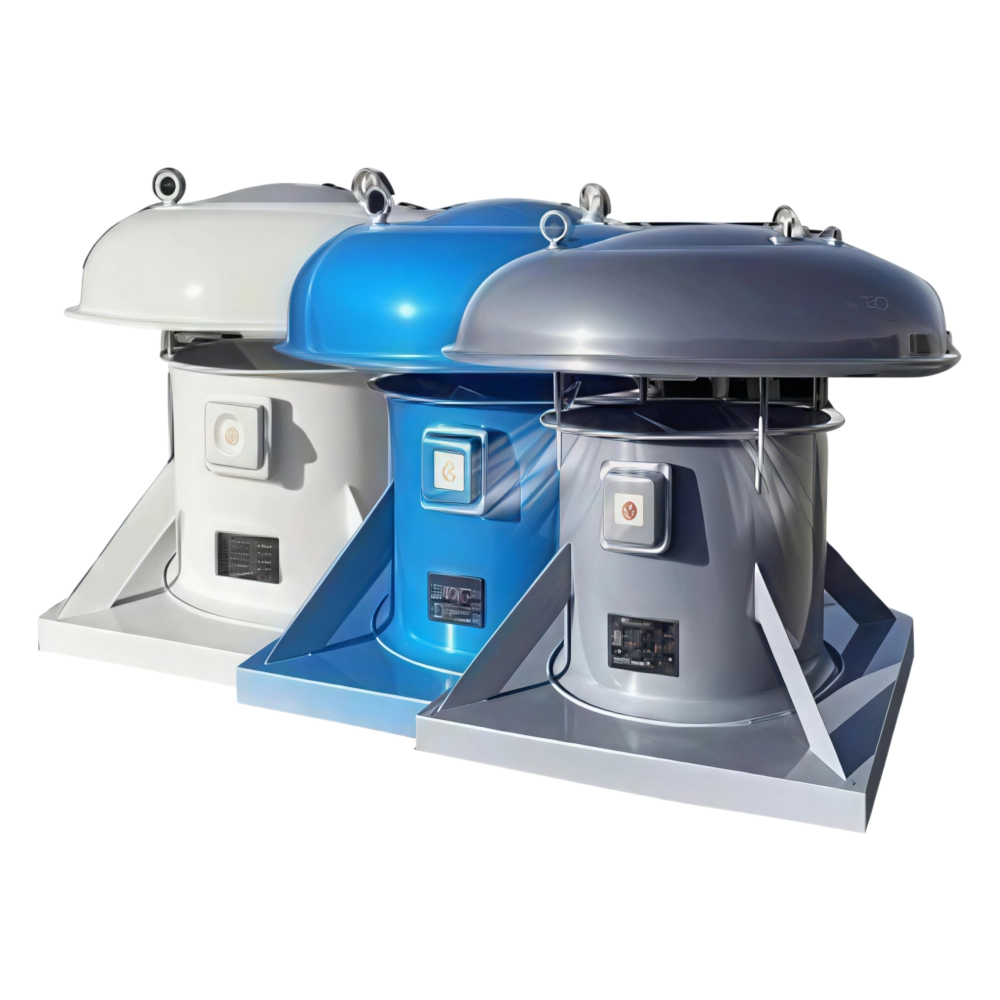
Factory roof exhaust fans serve workshops where heat, fumes and stale air build up under the roof through the working day. Every one of the manufacturer’s four rooftop pages lists factories or industrial workshops among its applications, and the elbow page adds the working principle: its fan creates a negative-pressure indoor environment while introducing fresh air. This page gathers the factory evidence from all four pages.
The slope page names textile, garment and hosiery, glass, molding, rubber, coating, toy, electronics, shoe, printing, food, dyeing and laundry workshops. The elbow page names textile mills, garment and hosiery, glass, plastic molding, rubber, coating and painting, toy, electronics, footwear, printing, food processing, dyeing and industrial laundry. The carbon-steel DWT-I page names factories generally, alongside warehouses, power stations, bus stations and gymnasiums. The FRP DWT-I page names industrial facilities generally, alongside warehousing and logistics, transportation hubs, commercial and public buildings, and energy and infrastructure projects. A factory buyer should read those lists as the trades the manufacturer has in mind, not as a guarantee for any particular process: a coating shop with solvent vapours and a food workshop with steam have different air problems, and the gas question must be asked explicitly, especially against the FRP page's stated gas limits.
The elbow page describes its fan as creating a negative-pressure indoor environment while introducing fresh air. In plain terms, the fan pulls air out of the building, and replacement air enters through openings, doors or supply paths, so the building's air is exchanged rather than recirculated. That principle is stated on the elbow page only, and this site attributes it there rather than presenting it as a property of every family. For it to work, the building needs an intake path sized for the air being removed: a fan that pulls air out of a sealed building will starve, and the exhaust route and the intake route must be planned together. No source page states an intake size, an air-change rate, or a pressure figure for a factory, so those belong in the project inquiry, with the building described, rather than in a general claim.
Factory air is rarely just hot air. Coating, dyeing, molding, rubber and food processes add fumes, steam, dust or odour, and the fan moving that air must suit what is in it. The FRP DWT-I page states the only gas limits any source page publishes, and those limits belong to the FRP page only — the figures are stated on the FRP page, not repeated here. A factory buyer must therefore state the process air honestly in the inquiry: what is in it, how hot it is, and how much of it there is. If the air is beyond what the stated variant allows, or if it is flammable or explosive, the answer may be a different variant — the carbon-steel page states an explosion-proof version is available — and that version must be confirmed with its own evidence, as the explosion-proof page sets out. Guessing about process air is how the wrong fan gets installed.
The slope models run at 28,000 and 45,000 m³/h with a 1.9-metre awning against rain and a waterproof dome-shaped cap. The elbow models run from 28,000 to 45,000 m³/h with noise figures from 55 to 65 dB, which matter where the factory sits near housing or offices. The DWT-I models run from 1,900 m³/h to 53,855 m³/h on the carbon-steel page and 53,800 m³/h on the FRP page, with the two different dimension schemes kept on their own pages. Factory roofs are often crowded — ducts, vents, skylights and access routes — so the overall dimensions and the roof opening deserve as much attention as the airflow, and the roof-mounted page gathers the dimension facts in one place.
Before ordering, confirm: the exact model and voltage for your site, the airflow and size you need, MOQ, lead time, and warranty. This page lists only what the source material verifies; anything not listed here is a question to ask, not a specification to assume.
Industrial applications and the DWT-I series claims.
What the source pages do and do not state about explosion-proof versions.
Roof openings, dimensions and mounting facts.
Send your building type, roof opening, and voltage, and ask for a layout using the fan families on this page. Before payment, confirm MOQ, lead time, voltage, and warranty for your order.