FRP rooftop exhaust fan
Slope and elbow powered families with their tables.
Rooftop exhaust fans from Foshan, China — FRP slope and elbow fans, carbon-steel and FRP axial DWT-I roof fans, for factories, warehouses, farms and commercial buildings.
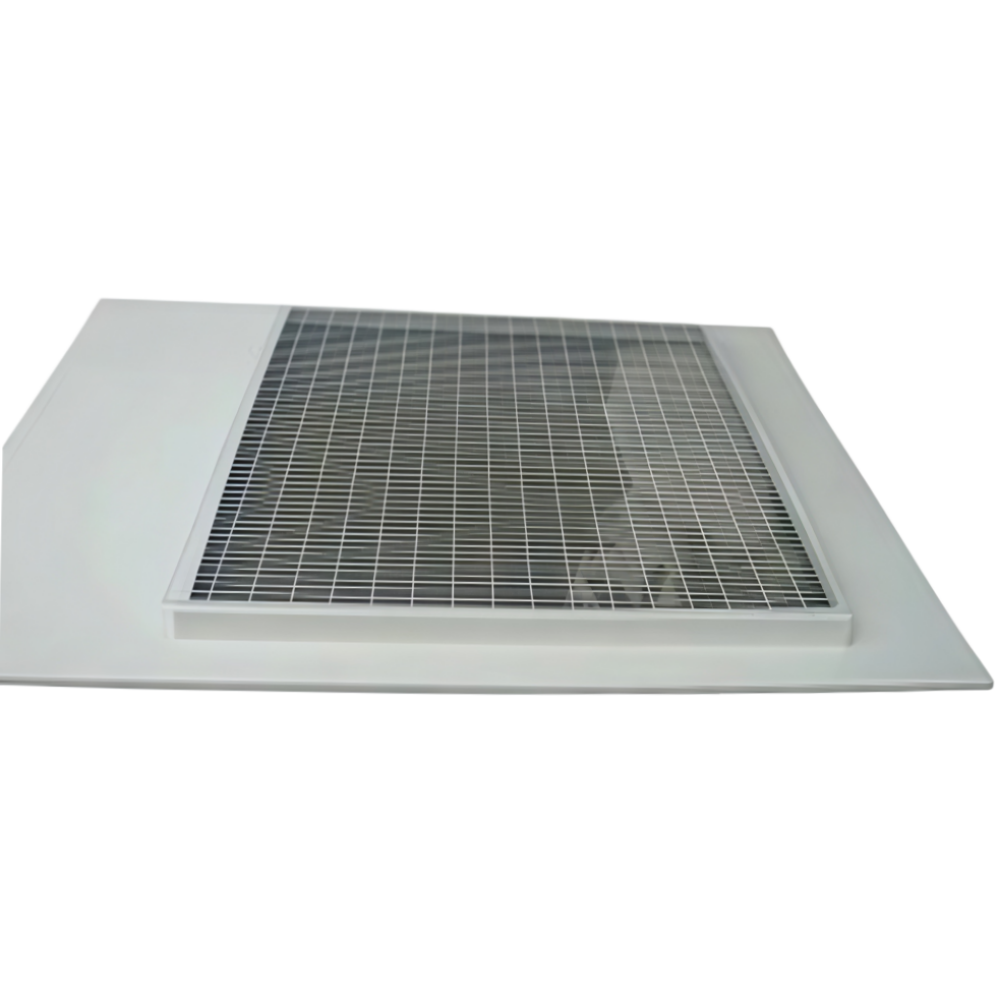
Rooftop air ventilator is the highest-volume search term in this site’s keyword set, and it is also the most misleading one for a buyer of powered fans: searches for it mostly return passive vents, not powered exhaust fans. This page is a guide that separates the two product classes, so a buyer orders the class the building actually needs.
A passive roof vent — a turbine vent, a whirlybird, a ridge vent, a static vent — has no motor. It turns or vents by wind and by the natural rise of warm air, and it publishes no rated airflow, no power and no pressure, because it has none of those things to rate. A powered rooftop exhaust fan has a motor, a rated power, a tabled airflow and, on the DWT-I pages, a tabled total pressure. The two classes solve different problems: a passive vent relieves a roof space, while a powered fan exhausts a working building at a stated rate. The manufacturer's pages list powered fans only. No passive vent appears on any source page, no passive vent is sold on this site, and no figure on this site belongs to a passive vent. A buyer who needs a stated airflow needs the powered families; a buyer who needs a passive vent needs a different supplier.
Checking the top results for rooftop air ventilator confirms the split: turbine vents, roof-vent guides, marketplace vent listings and best-roof-vents videos, with no industrial powered-fan manufacturer among the top results. That is a statement about search results, not about products, but it explains why the confusion happens: the same words cover both classes, and the results a buyer sees first are mostly the passive class. The volume behind the term — 14,800 searches a month — is largely passive and residential vent intent, not powered-fan buyer intent, and this site does not treat it as a powered-fan head term. The ventilator term is kept on this guide page only, where it can do its real job: steering the buyer to the right class before any model is discussed.
For buyers who settle on powered exhaust, the families are the slope and elbow FRP fans, with airflows from 28,000 to 45,000 m³/h, and the DWT-I axial range, with tabled airflows from 1,900 m³/h to 53,855 m³/h on the carbon-steel page and 53,800 m³/h on the FRP page. The slope family carries a waterproof dome-shaped cap and a 1.9-metre awning; the elbow family carries PVC shutters and publishes noise figures from 55 to 65 dB; the DWT-I families carry the two different dimension schemes kept on their own pages. All of those figures are tabled on the family pages, and none of them belongs to a passive vent. A buyer comparing a powered fan against a passive vent on price alone is comparing a rated machine against an unrated opening, and the comparison misleads in exactly the way this guide exists to prevent.
Before ordering, confirm: the exact model and voltage for your site, the airflow and size you need, MOQ, lead time, and warranty. This page lists only what the source material verifies; anything not listed here is a question to ask, not a specification to assume.
Slope and elbow powered families with their tables.
The powered axial range with its tables.
The selection sequence for powered fans.
Send your building type, roof opening, and voltage, and ask for a layout using the fan families on this page. Before payment, confirm MOQ, lead time, voltage, and warranty for your order.