How to Read a DWT-I Performance Table
A table with two readings per row
The DWT-I table looks plain: eleven models, five columns, one row each. Then the slashes start. DWT-I-3A reads 0.18 / 0.37 kilowatts, 1450 / 2900 revolutions per minute, 1900–2120 / 2600–3300 cubic metres per hour, and 110–90 / 222–161 pascals. Read the first figure of every pair and you get one fan. Read the second and you get another. Both readings come from the same row. This article shows how the table is printed, what the paired figures mean, and the misreadings that order the wrong fan.
The five columns, in plain terms
Model names the row. Power, in kilowatts, is the motor power at that operating point, and speed, in revolutions per minute, is the impeller speed there. Volume flow, in cubic metres per hour, is the air moved at that point, written as a range because flow shifts across the working curve. Total pressure, in pascals, is the pressure developed at the same point, also a range, written high-to-low — pressure falls as flow rises along the curve. No column is a maximum to quote on its own. The flow range and the pressure range belong together, at one operating point: put the highest flow beside the highest pressure from opposite ends of the ranges and you have invented a fan the table never describes.
Slash entries are operating points, not options to mix
Every slash-separated pair is its own operating point for the same model, in page order. The first power belongs with the first speed, the first flow range and the first pressure range; the second entries belong together the same way. DWT-I-6A is tabled at three points — 0.55, 1.1 and 1.5 kilowatts at 710, 960 and 1500 revolutions per minute — and DWT-I-11.2A at one: 7.5 kilowatts at 960 revolutions per minute, moving 41,000 to 53,855 cubic metres per hour on the carbon-steel page. So a model is not one fan but two or three, depending on the motor and speed fitted. An inquiry has to name the operating point, not only the model number: a supplier quoting DWT-I-6A without saying which power and speed applies has quoted a range, not a fan.
Eleven rows, and the series claims above them
Only eleven rows carry per-model specifications, DWT-I-3A through DWT-I-11.2A. Above the tables, the carbon-steel page makes series-level claims: 17 machine numbers from 300 to 2400 mm impeller diameter, a series airflow of 15,000 to 220,000 cubic metres per hour, and a total pressure of 60 to 320 pascals. The axial page quotes those claims as page-level claims only. The gap is the point. Tabled rows top out at 53,855 cubic metres per hour — far under the 220,000 series figure — and tabled pressures top out at 307 pascals on one operating point of DWT-I-10A. A buyer needing a figure beyond the tabled rows has to ask for the model carrying it, with its own row, instead of reading the series claim as a specification. The 17-number wording is never expanded on this site into models with no table row.
Two dimension schemes, kept apart
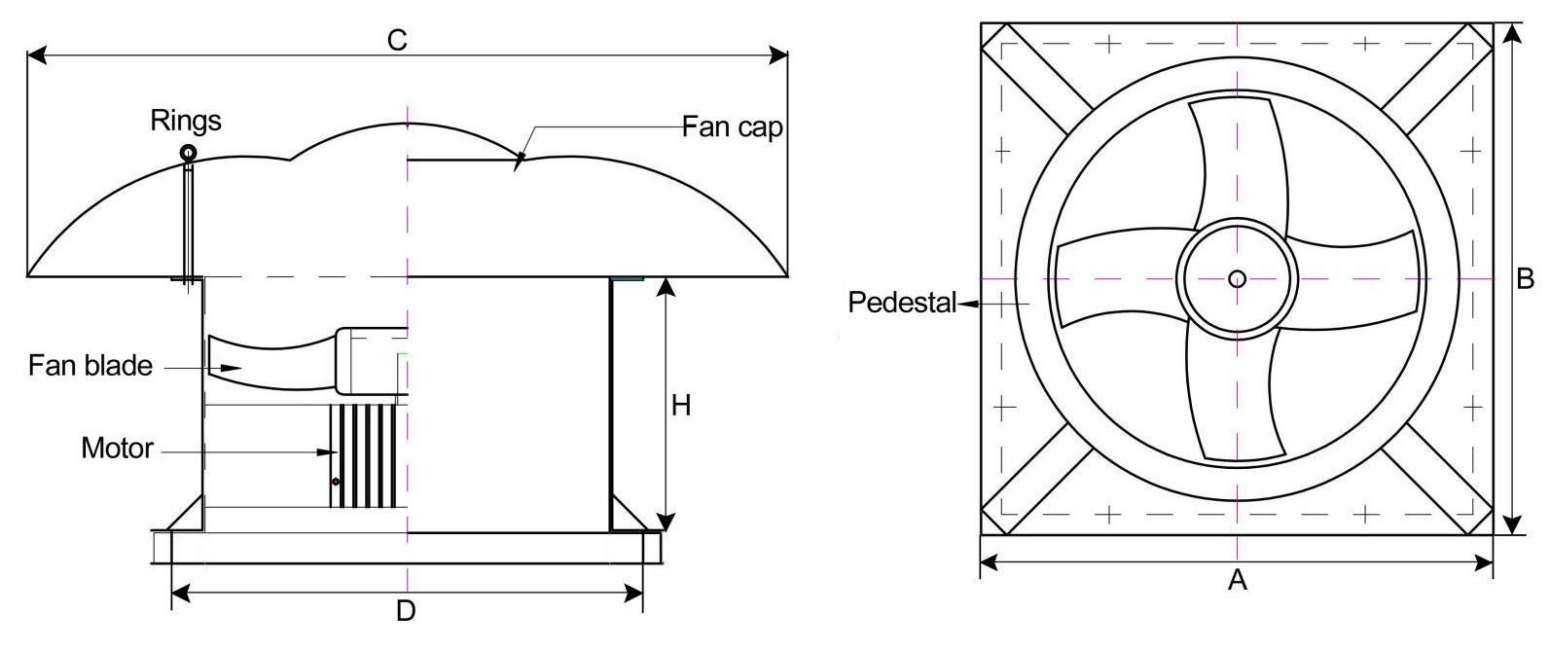
The performance tables match between the two DWT-I pages bar one figure. The dimension tables do not match at all, because they are different schemes. Carbon steel uses five columns — A, B, C, D and H — with H running from 230 mm on the smallest model to 850 mm on the largest. The FRP page uses seven — diameter A, diameter B, C, D, E, F and H — with H reading 68 mm on every row. Those FRP H figures are recorded as printed and not reinterpreted as a fan height: the FRP scheme reads as a flange or base thickness in another dimensioning system. Matching a roof opening means using the dimension table of the variant being ordered, on its own page, and never carrying a column from one scheme onto the other. The two pages stand separately on this site for exactly that reason.
The one figure that differs: 53,855 against 53,800
Row for row, the performance tables are identical except DWT-I-11.2A. Its top-end volume flow reads 53,855 cubic metres per hour on the carbon-steel page and 53,800 on the FRP page — 55 cubic metres per hour apart, about a tenth of one percent. Every other row matches exactly: all powers, speeds and pressures. This site quotes each page's own figure on its own page and states the difference instead of quietly unifying them. A specification unified in silence is a specification that has been edited, and edited specifications are how wrong fans get ordered. In practice the two figures are the same fan. On the record they are two printed figures, and the record keeps them separate.
Gas limits live on one page only
Only the FRP DWT-I page states limits for the gas to be transported — free of sticky substances, a temperature ceiling, and a substance-mass ceiling. Those limits stay on the FRP page. They are not transferred to the carbon-steel page, and they are not repeated elsewhere on this site as general DWT-I facts. The reason is evidence, not tidiness: one page states them, so one page carries them. A buyer moving hot, dusty or sticky gas checks the actual gas against the FRP page's figures where the FRP variant is considered, and asks for the corresponding limits for carbon steel instead of assuming they match. The explosion-proof statement gets the same treatment: it stands on the carbon-steel page only, and the explosion-proof page treats it in full.
Accessories, options, and what is not in the table
Both DWT-I pages list optional accessories: gravity or electric check valves, anti-bird and insect nets, maintenance switches and centralized control boxes. The carbon-steel page adds adjustable blades on machine numbers 12 and above, an explosion-proof version, and dual-speed or variable-frequency motors with a recommended locked adjustment frequency of 25 to 50 Hz. Those are page statements to confirm model by model — not standard features, not table entries. What the tables leave out matters just as much: no voltage column, no noise column, no weight, no MOQ, no lead time, no price, no certificate number. A buyer who needs any of those has to ask. And a supplier who answers from another family's table — borrowing a voltage from the slope page, say — is answering from the wrong evidence. The table is complete for what it covers and silent on the rest. Reading it well means respecting both halves.
Reading the table in an inquiry
The table's best use is writing the inquiry from it: model number, operating point, power, speed, flow range and pressure range, copied from the row, plus the dimension table of the same variant, plus the building facts no table supplies — the roof opening, the voltage, the gas, the control wanted. A supplier receiving that inquiry can answer with a layout. A supplier receiving only a model number has to guess the operating point, and guesses get installed. Read each row across, keep the pairs together, keep the two dimension schemes apart, and let the figures that differ stay different. That is all the table asks of its reader. It is enough.
Facts used here come from the manufacturer's own product pages for the carbon-steel and FRP DWT-I rooftop fans. No figure appears here that those pages do not state, and where the two pages differ, the difference is stated rather than resolved.
Request a rooftop fan layout
Send your building type, roof opening, and voltage, and ask for a layout using the fan families on this page. Before payment, confirm MOQ, lead time, voltage, and warranty for your order.